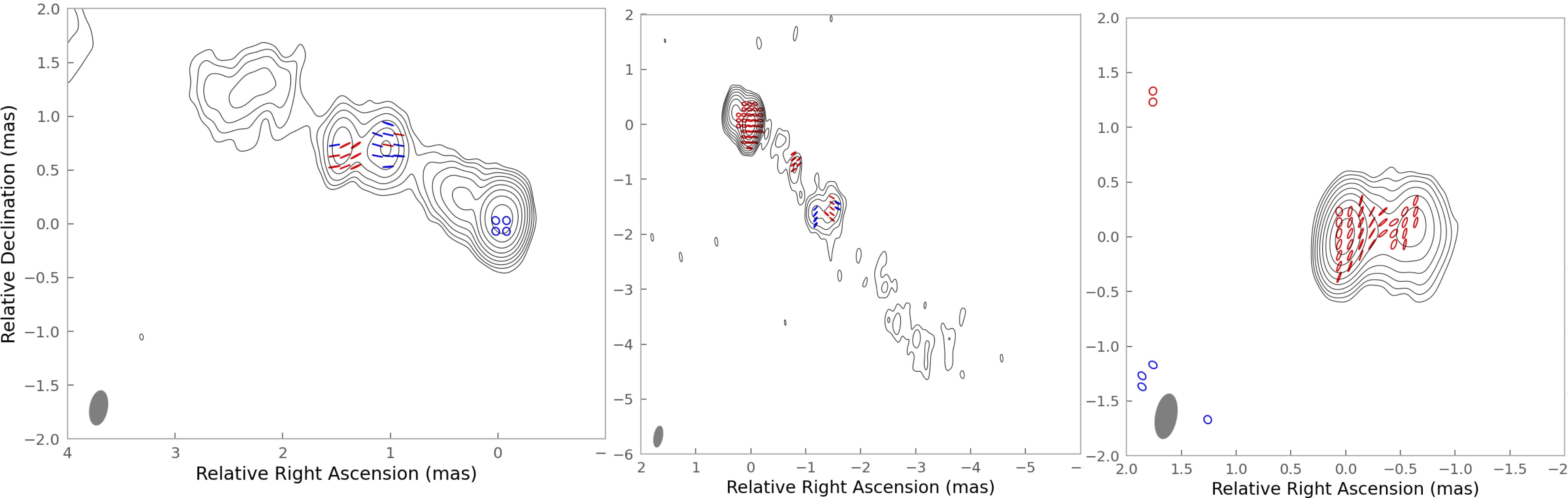
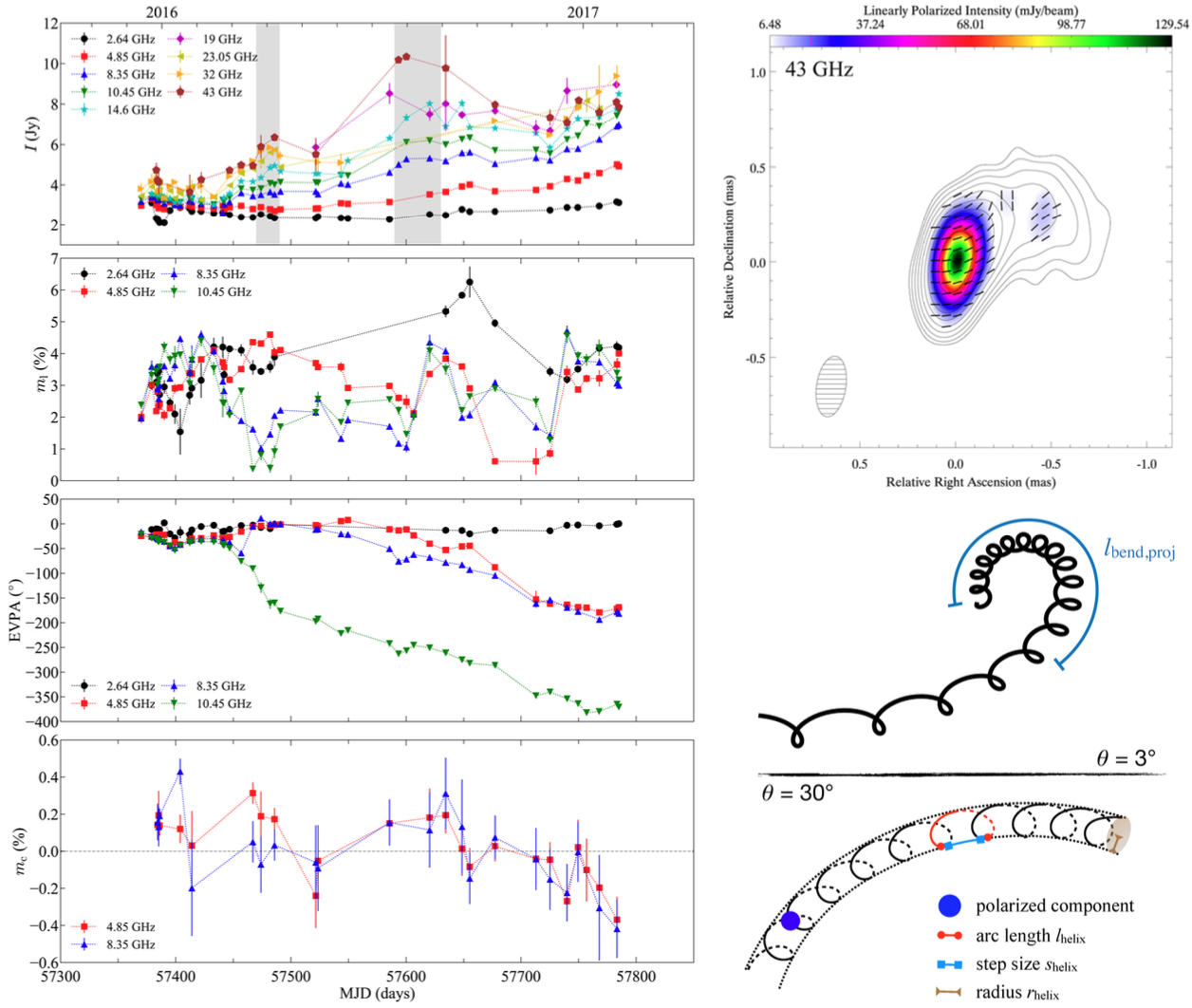
I am mostly interested in the study of AGN jet micro- and macro-physics, including their magnetic field characteristics as well as their plasma energetics, using multi-frequency polarization studies and the combined analysis of multi-dimensional data cubes in all Stokes parameters. An example of this combined analysis of interferometric and single-dish polarization observations is described in Myserlis et al. (2018b, A&A, 619, A88). The multi- frequency LP and CP curves for the blazar OJ 287 show a long polarization angle (EVPA) rotation of about 340º. The synergy of high-cadence single dish observations and high-angular resolution VLBA polarization maps at 15 and 43 GHz, resulted in stringent constraints of the jet structure and its magnetic field geometry. The EVPA rotation was attributed to a jet component propagating on a bent, helical trajectory at the inner jet.
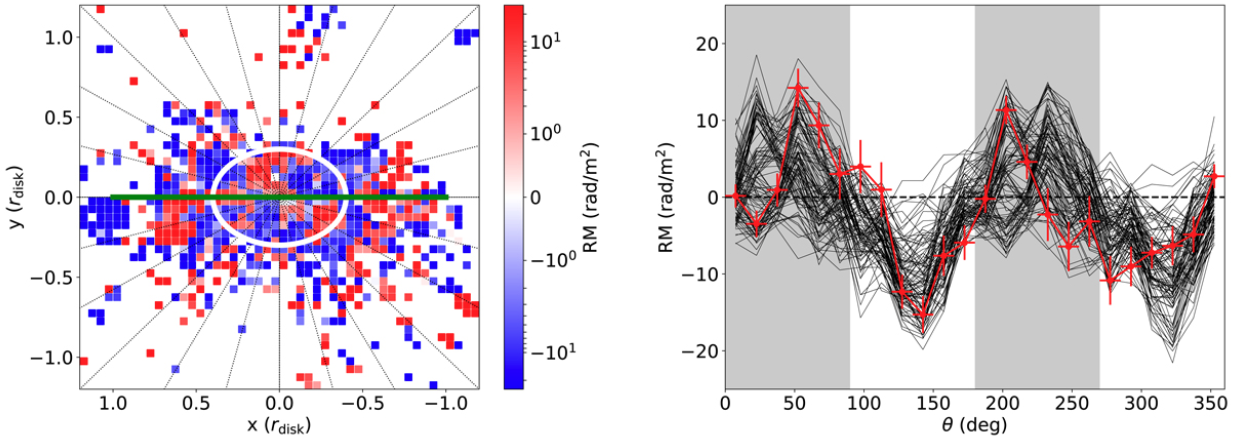
Similarly, in Myserlis & Contopoulos (2021, A&A, 649, A94), we provide direct observational evidence for a persistent, universal toroidal magnetic field pattern that seems to be present in all galactic halos. Our analysis is based on polarization data obtained with the Very Large Array (VLA) that were used to create rotation measure (RM) maps for several nearby spiral galaxies seen edge-on. The universal magnetic field orientation that we revealed is consistent with the predictions of the Cosmic Battery mechanism (Contopoulos & Kazanas 1998, ApJ, 508, 859) for generating large scale magnetic fields around active gravitating compact objects.
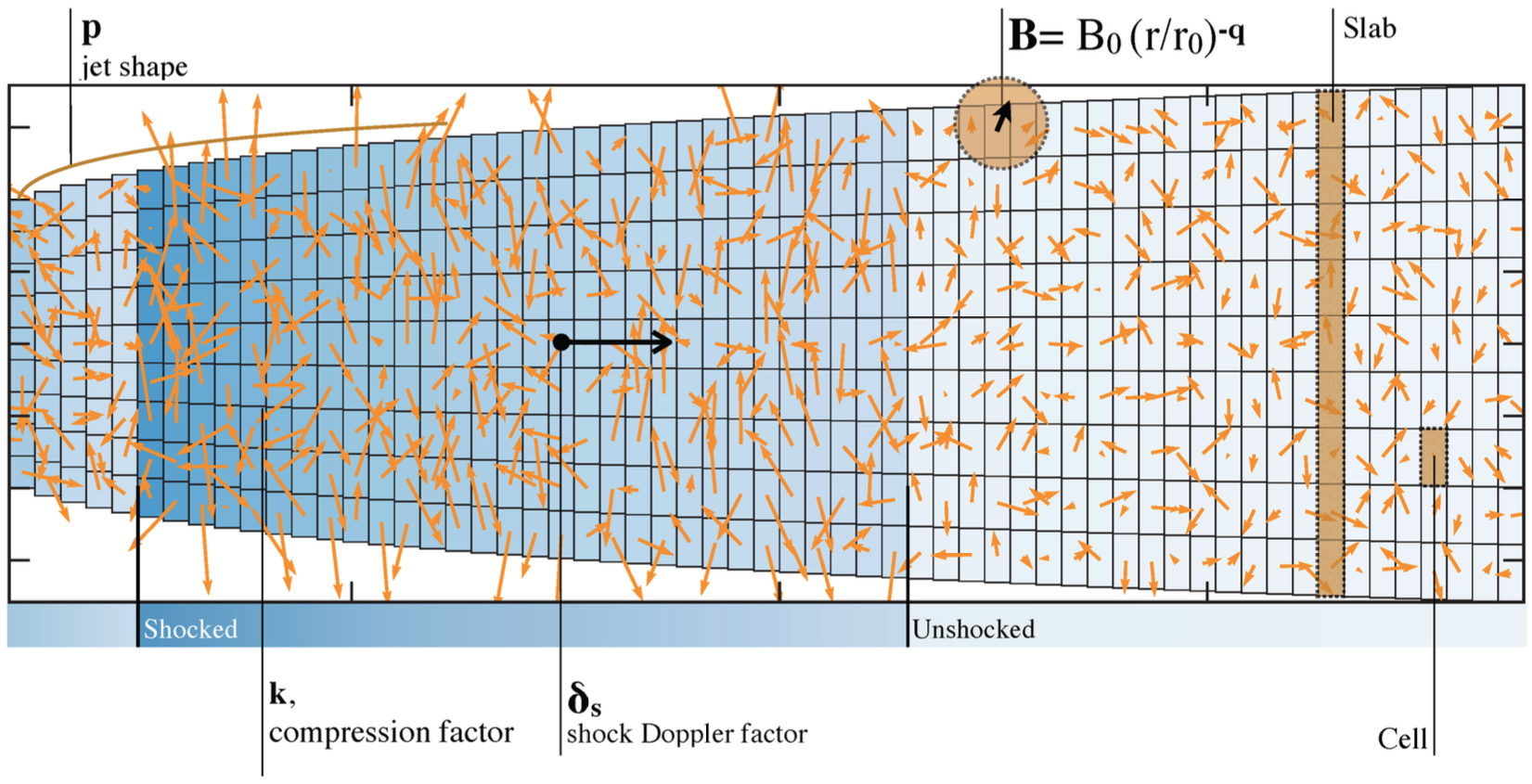
The direct comparison of observed and synthetic polarimetric datasets provides stringent contraints on the studied physical conditions. To that end, I developed a full-Stokes polarized radiative transfer model to emulate the polarized emission of astrophysical plasma systems in all four Stokes parameters I, Q, U and V, accounting for a number of emission, absorption and propagation mechanisms, such as Faraday Rotation and Conversion. In Myserlis et al. (2016, Galaxies, 4, 58) we use the model to reproduce the behavior observed in the blazar 3C 454.3 and constrain several physical conditions, such as the coherence length of the magnetic field, the shock compression factor and the Doppler factor. The model performs well also in low-energy plasmas, where the Faraday rotation and conversion effects play an important role, as shown for the nuclear outflow of the galaxy NGC 4845 in Angelakis et al. (2017, Galaxies, 5,81).
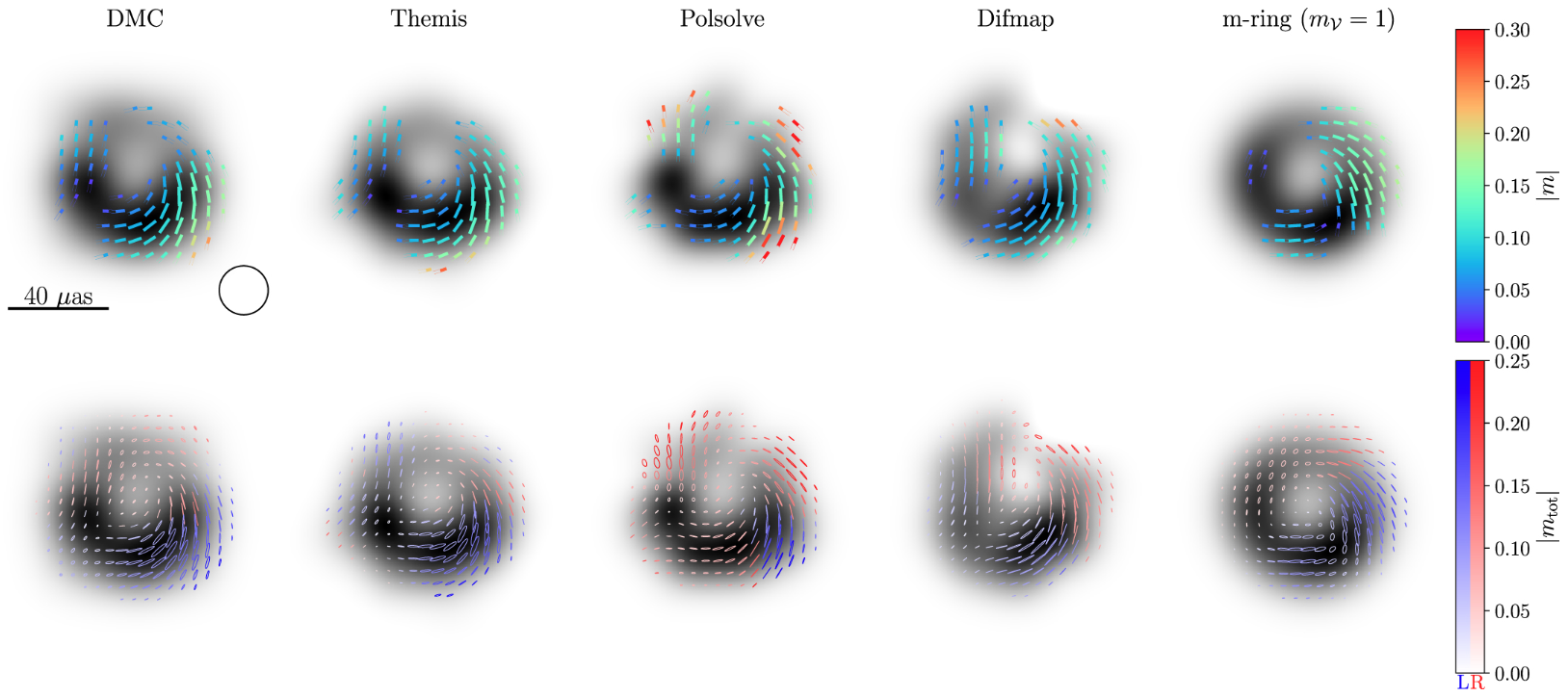
The variable, multi-band CP and LP of AGN jets is monitored through several international collaborations that I lead or actively participate, such as the SMAPOL (PI), QUIVER (PI), POLAMI, F-GAMMA, BEAM-ME and IXPE projects. In particular, I am recently focused on the effort to calibrate and image the circular polarization (CP) of AGN jets observed at mm wavelengths (43 GHz) with VLBA in the framework of the BEAM-ME monitoring program. Our results show that significant CP is detected for at least a third of the monitored AGN jets, suggesting that the magnetic fields are stronger and more ordered close to their central engine (Myserlis et al., in prep). In addition, as a member of the Event Horizon Telescope (EHT) Collaboration, I work mostly for the Polarimetry Working Group to recover the polarization images of the main EHT targets, M87* and SgrA*, especially their CP (EHTC 2023, ApJL, 957, L20).
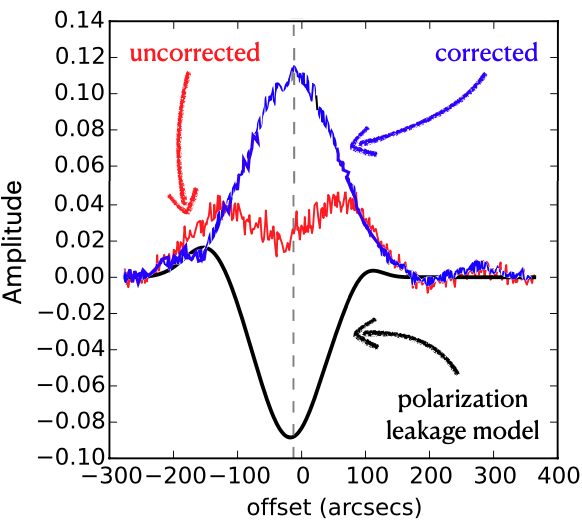
Finally, I am particularly interested in the advancement of circular and linear polarimetric techniques with the aim to improve the accuracy and precision of CP and LP observations. This is especially important for AGN jets that usually show low levels of polarization, especially CP, and prominent variability. This has led to the development of a novel end-to-end data analysis methodology (Myserlis et al. 2018, A&A, 609, A68) to treat several instrumental effects effectively and extract radio CP and LP with high accuracy (polarization degree uncertainty ∼0.1%–0.2%). The methodology is used to recover the polarization parameters of the AGN jets monitored by the QUIVER and F-GAMMA programs as a means to study their physical conditions and their evolution over time. Additionally, in terms of polarimetric instrumentation, I am currently leading a project to improve the accuracy of CP observations with the IRAM 30m telescope and I was actively involved in the commissioning of the polarization mode of its NIKA2 continuum camera.

Institut de Radioastronomie Milimétrique (IRAM)
Avenida Divina Pastora 7, 18012
Granada
Spain


