Molecular line ratios map the ionization fraction across Orion B
Back to all ORION-B & DAOISM results
The small fraction of free electrons in molecular gas has a disproportionate influence on interstellar physics: it drives ion-molecule chemistry, affects molecular excitation, and couples otherwise neutral gas to magnetic fields. Building on molecular diagnostics identified from chemical models, we used ORION-B observations to estimate the ionization fraction over almost an entire giant molecular cloud.
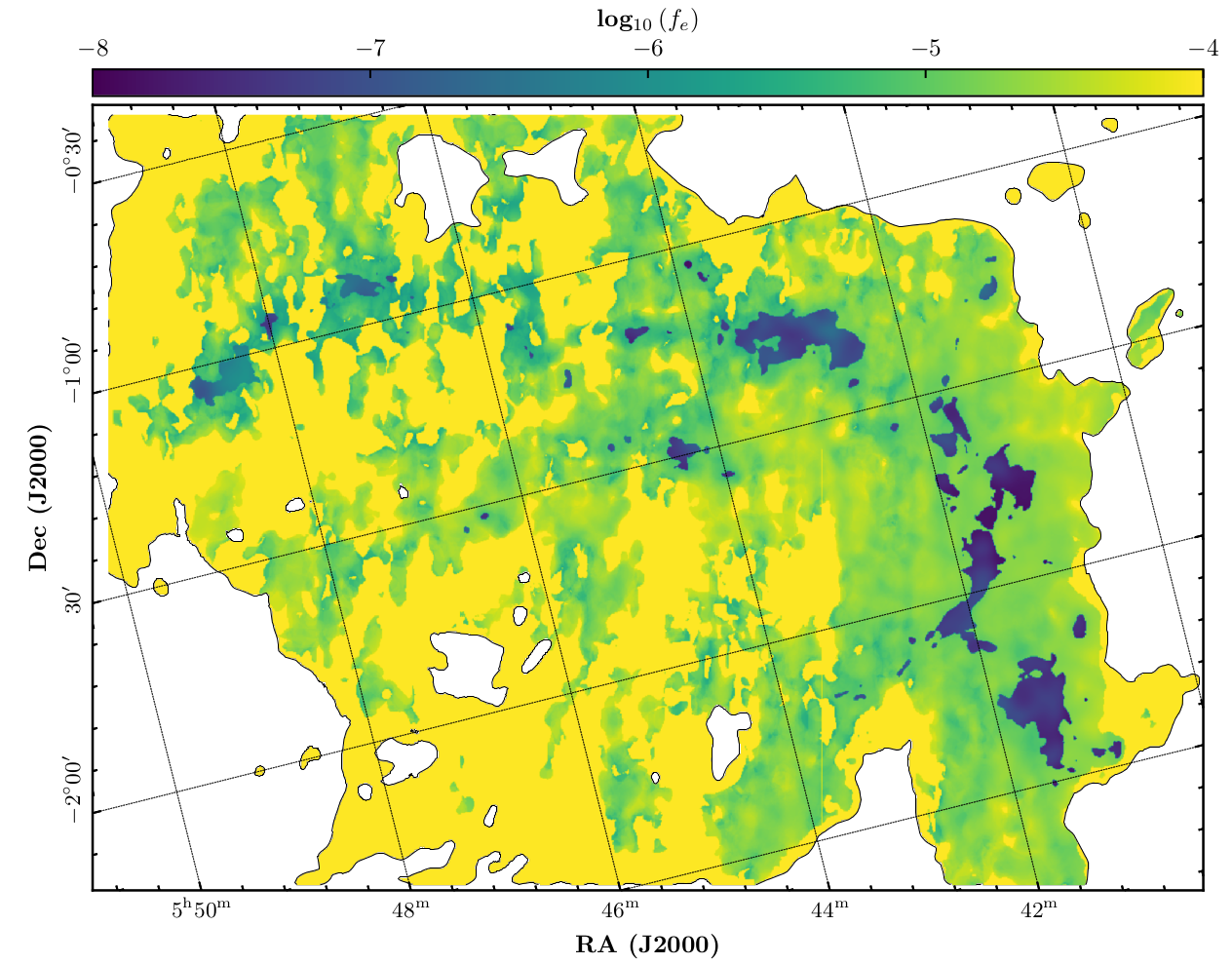
The resulting map reveals a strong contrast between cloud regimes. In translucent gas, the ionization fraction lies around 10^-5.5 to 10^-4, while in dense gas it falls to about 10^-8 to 10^-6. In both regimes it decreases with increasing gas density and increases with the strength of the UV radiation field. The relatively high electron abundance in translucent gas is large enough for electron collisions to contribute significantly to the excitation of molecules such as HCN and HNC.
This is the first large-scale estimate of the ionization fraction across both dense and translucent gas in Orion B. It transforms an important but difficult-to-observe physical quantity into a mapped property of the cloud and connects its chemistry, magnetic coupling, molecular excitation, and exposure to stellar radiation.
Figure: Map of the ionization fraction across Orion B at 0.24 pc resolution. The color scale spans four orders of magnitude and directly shows the contrast between highly ionized translucent material and the much lower ionization fractions reached in dense regions.