Molecular emission identifies distinct physical environments in the cloud
Back to all ORION-B & DAOISM results
Different regions of a molecular cloud are shaped by different combinations of density, shielding, chemistry, and illumination. Rather than defining these regions beforehand from a single tracer, the ORION-B survey makes it possible to ask whether the molecular emission itself can reveal the natural organization of the cloud. We used unsupervised clustering on the intensities of multiple molecular lines to group positions that share similar spectral properties.
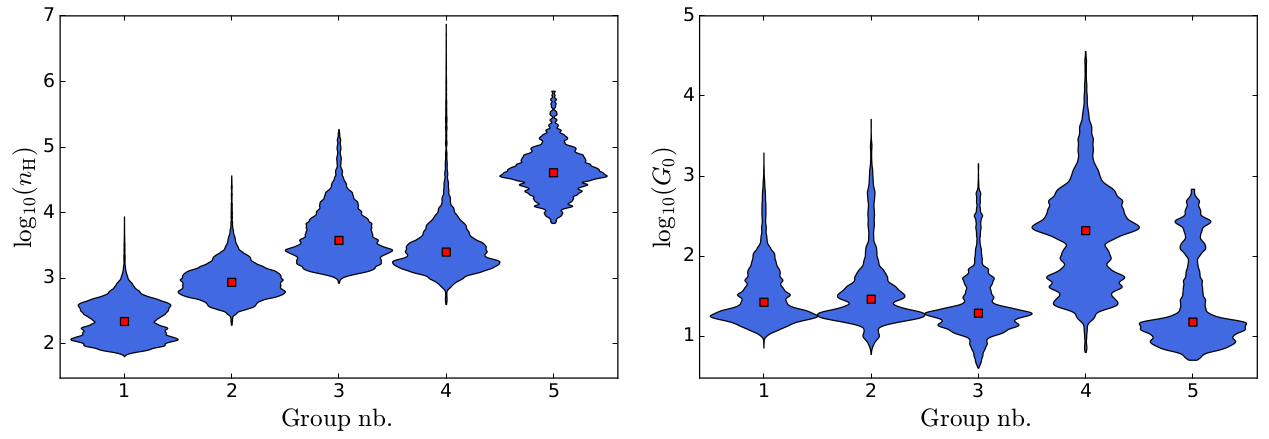
The resulting clusters correspond to physically distinct environments. They separate diffuse and translucent gas, denser molecular material, and regions strongly influenced by nearby ultraviolet radiation. The spatial distribution of the clusters follows recognizable structures in Orion B, showing that the classification is not merely statistical: it recovers meaningful regimes of the interstellar medium from the molecular-line data alone.
This demonstrates that multi-line observations can be used as a data-driven classifier of interstellar environments. Such an approach is particularly useful when the relevant physical regimes are mixed within large datasets, or when no single molecular line provides an unambiguous definition of the regions of interest.
Figure: Map of the spatial clusters obtained from the molecular-line intensities, together with their characteristic emission signatures. The clusters occupy distinct parts of Orion B and correspond to different physical and chemical regimes of the cloud.