Molecular line ratios reveal the ionization fraction of interstellar gas
Back to all ORION-B & DAOISM results
Even in predominantly neutral interstellar gas, a small fraction of atoms and molecules are ionized. This ionization fraction controls important processes: it couples the gas to magnetic fields and drives much of the ion-molecule chemistry. Measuring it over an entire molecular cloud is difficult, however, because traditional diagnostics such as DCO+/HCO+ are mainly accessible in dense cores. We therefore searched large grids of astrochemical models for molecular observables that retain information about the ionization fraction over a much wider range of physical conditions.
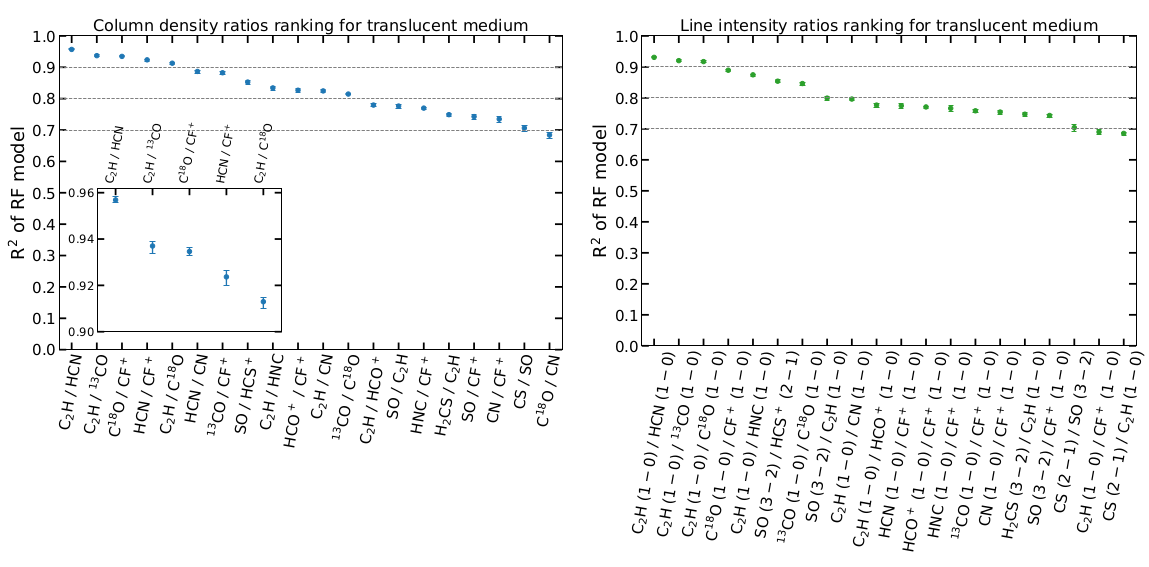
The model grids reveal several molecular column-density and line-intensity ratios that predict the ionization fraction with high accuracy in both translucent and cold dense gas. In translucent conditions, ratios involving C2H and HCN, HNC, or CN are particularly informative. In dense gas, useful diagnostics include CF+/DCO+, 13CO/HCO+, and CN/N2H+. Several of these diagnostics remain useful when observational noise is included, and simple analytical relations can be derived to estimate both the ionization fraction and its uncertainty.
This turns a quantity that cannot be observed directly into one that can be constrained from accessible molecular emission. More generally, the same strategy provides a systematic way of mining large physical and chemical model grids to discover observable diagnostics of otherwise inaccessible quantities.
Figure: Ionization fraction as a function of the best molecular ratio for translucent gas, shown for both column densities and observable line intensities. The tight trends illustrate how a molecular ratio can be converted into a quantitative estimate of the ionization fraction.