Deep learning recovers faint molecular emission without distorting line profiles
Back to all ORION-B & DAOISM results
The study of stellar formation and galaxy evolutions is being profoundly transformed by the commissioning of new receivers that can probe the detailed atomic and molecular composition of astrophysical media, as well as the kinematics of the emitting gas. Most of the new instruments provide massive data cubes that contain a lot of information spatially and spectrally. However, their large size coupled with an inhomogeneous signal-to-noise ratio are major challenges for consistent analysis and interpretation. Current leading algorithms are unable to extract all the information from noisy data. It is therefore necessary to invent more modern methods at the frontier between astrophysics, signal processing and data science to get the maximum scientific return of these new observations.
Autoencoders neural networks have been successfully used to denoise data Earth remote sensing hyperspectral data. We have taken this type of approach steps further by taking advantage of the statistical properties of astrophysical data cubes. In particular, the absence of redundancy between distant spectral channels and the sparsity of the signal have been used. This results in a new algorithm based on an innovative architecture and loss function.
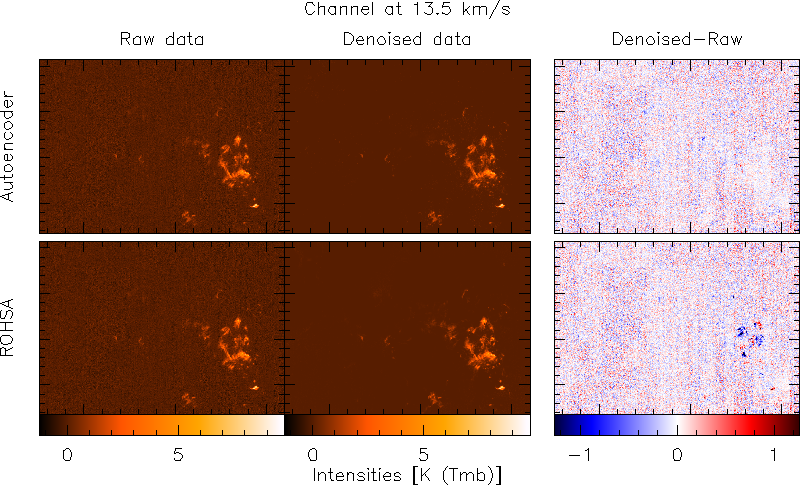
Our new method leads to an increase in the signal-to-noise ratio in data with a weak signal, allowing us to use faint but very informative signals. At the same time, it preserves the spectral shape of the profiles with a high signal-to-noise ratio, contrary to previous state-of-the-art methods such as ROHSA, a Gaussian profile decomposition algorithm. Indeed, we show that our method distorts the signal less, providing more reliable atomic and molecular line profiles. It has been applied to data from the IRAM 30m large program ORION-B, but is perfectly usable on data cubes from other modern telescopes and instruments (VLT/MUSE, JWST, ALMA, etc).
Figure: Comparison between autoencoder (first row) and ROHSA (second row) denoisings of a 13CO (1—0) velocity channel. The last column shows the residuals of the methods and illustrate the fact that previous state-of-the-art algorithm can distort the signal, whereas the autoencoder does not.