Gas flows around filaments reveal accretion and stellar feedback
Back to all ORION-B & DAOISM results
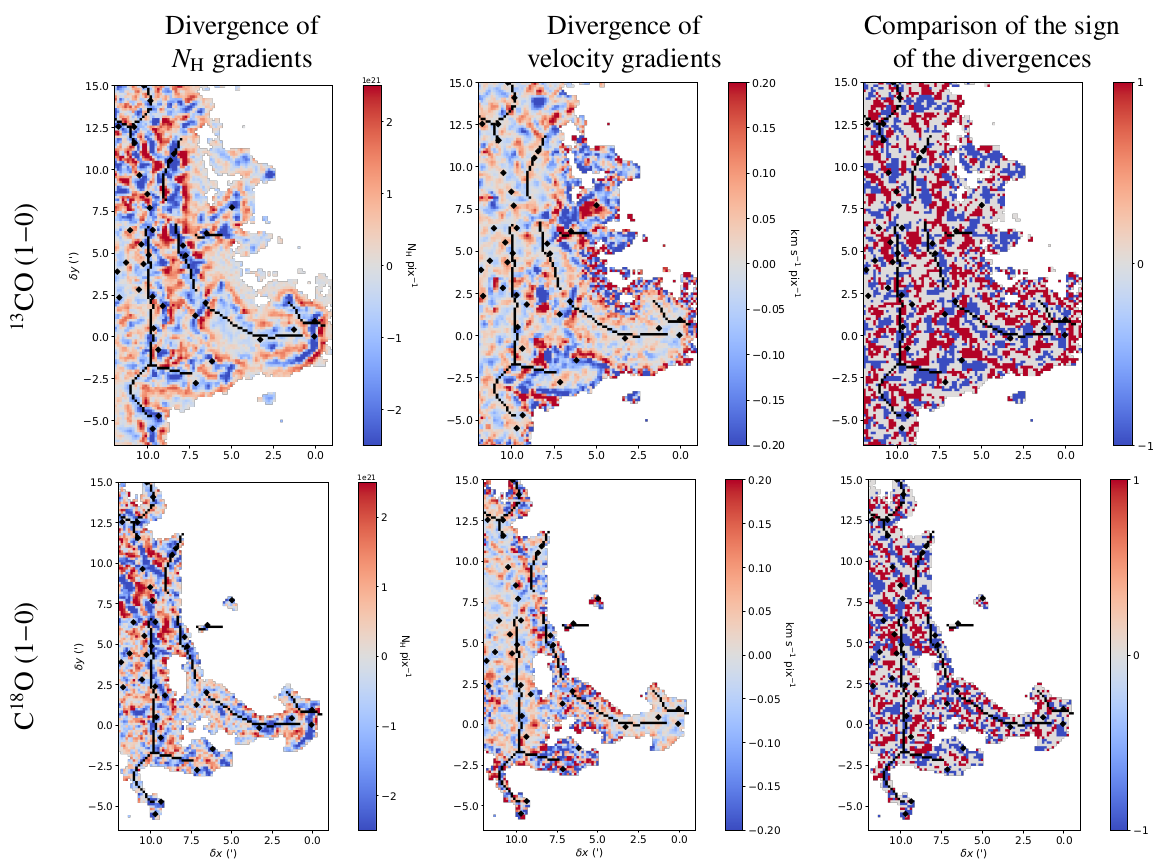
Filaments are the structures within molecular clouds where dense cores and stars preferentially form. Their evolution depends on how gas moves around and along them, and on how nearby massive stars reshape their environment. Using the ORION-B 13CO and C18O observations, we separated the cloud into three velocity layers and compared the spatial gradients of gas column density and velocity around the filamentary structures.
The observed kinematic patterns are dominated by motions perpendicular to the filament axes, as expected for radial flows that can either feed a filament or move material away from it. We do not find a comparable large-scale signature of longitudinal flows along the filaments. Several regions also show asymmetric flow patterns, particularly where filaments lie at the edge of an H II region, revealing the dynamical influence of feedback from young massive stars.
These measurements provide a direct observational link between the formation and evolution of filaments and the dynamics of their surroundings. They show that filaments can be shaped both by radial gas flows and by externally driven compression, and provide a statistical method that can be applied to other molecular clouds to characterize these motions.
Figure: Divergence of the column-density and velocity gradients around the Horsehead filament. Regions where the two gradients converge or diverge together reveal coherent gas motions around the filament and provide the observational signature used to identify radial flows.