Molecular lines organize themselves according to the physics of the cloud
Back to all ORION-B & DAOISM results
A molecular cloud is observed through many emission lines, each sensitive to a different combination of density, column density, chemistry, excitation, and radiation field. The challenge is to understand whether this large collection of observables contains a simpler underlying organization. Using the ORION-B 3 mm survey, we applied principal component analysis to the spatial distributions of the detected lines in order to identify the dominant patterns shared by the molecular emission.
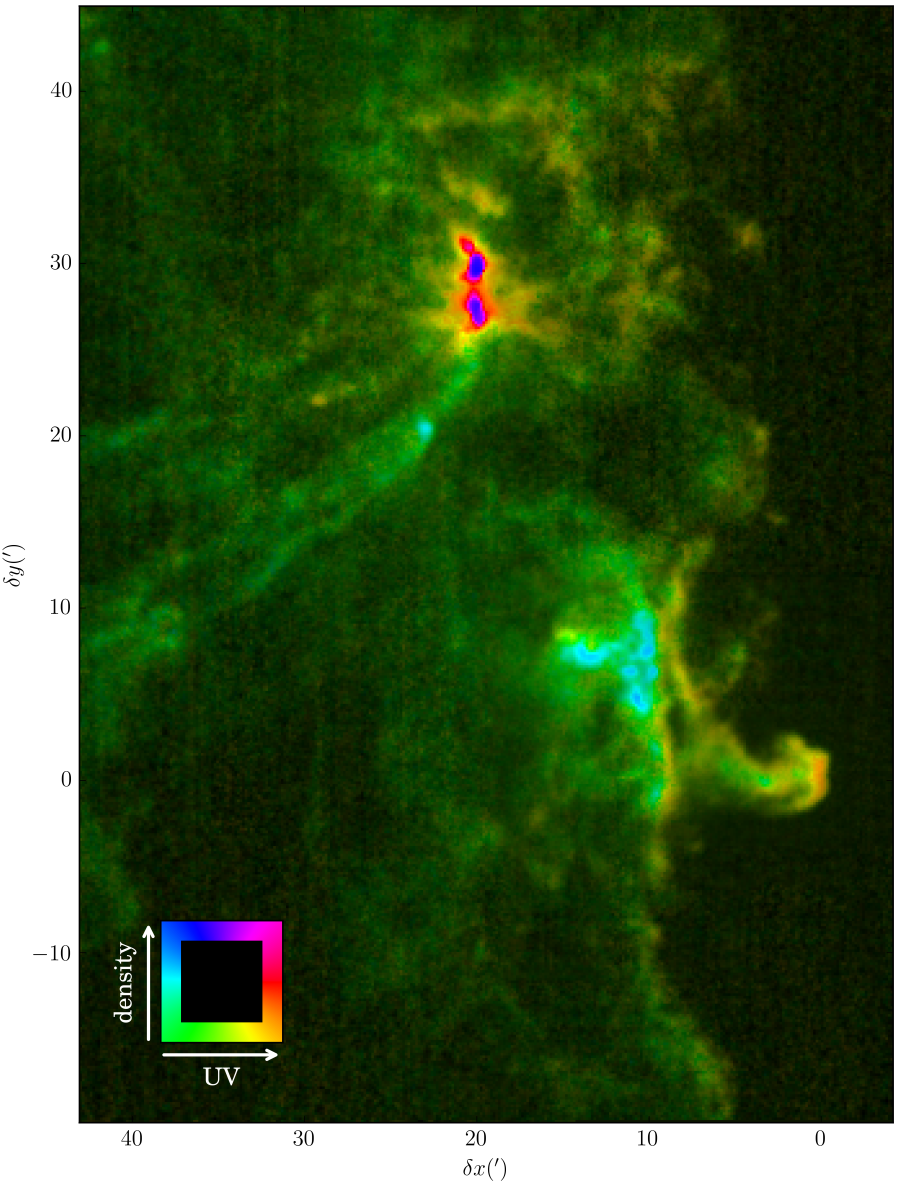
A small number of components accounts for most of the variance in the data, and these components have clear physical interpretations. The first principal component follows the overall amount of molecular material. Subsequent components separate regions of denser gas from regions more strongly exposed to ultraviolet radiation. Molecular species that are chemically or radiatively related naturally group together through their similar spatial behavior.
This result shows that the chemical complexity of a molecular-line survey is not arbitrary: the combined emission carries a low-dimensional imprint of the main physical conditions in the cloud. Multivariate analysis can therefore extract physically meaningful information directly from rich spectral surveys, without assigning a single fixed role to each molecular line in advance.
Figure: Projection of the molecular-line maps onto the first principal components. The dominant components separate the large-scale distribution of matter from variations associated with dense gas and UV-illuminated regions, revealing the main physical dimensions encoded in the line survey.