Combining molecular lines recovers the amount of molecular gas
Back to all ORION-B & DAOISM results
Cold molecular hydrogen is essentially invisible under the conditions found in molecular clouds, although it contains most of their mass. Its column density is therefore usually inferred indirectly, for example from dust emission or from individual molecular tracers. The ORION-B survey offers another possibility: combine the information carried by many millimeter molecular lines and learn their relationship to the H2 column density using a resolved cloud for which an independent dust-based estimate is available.
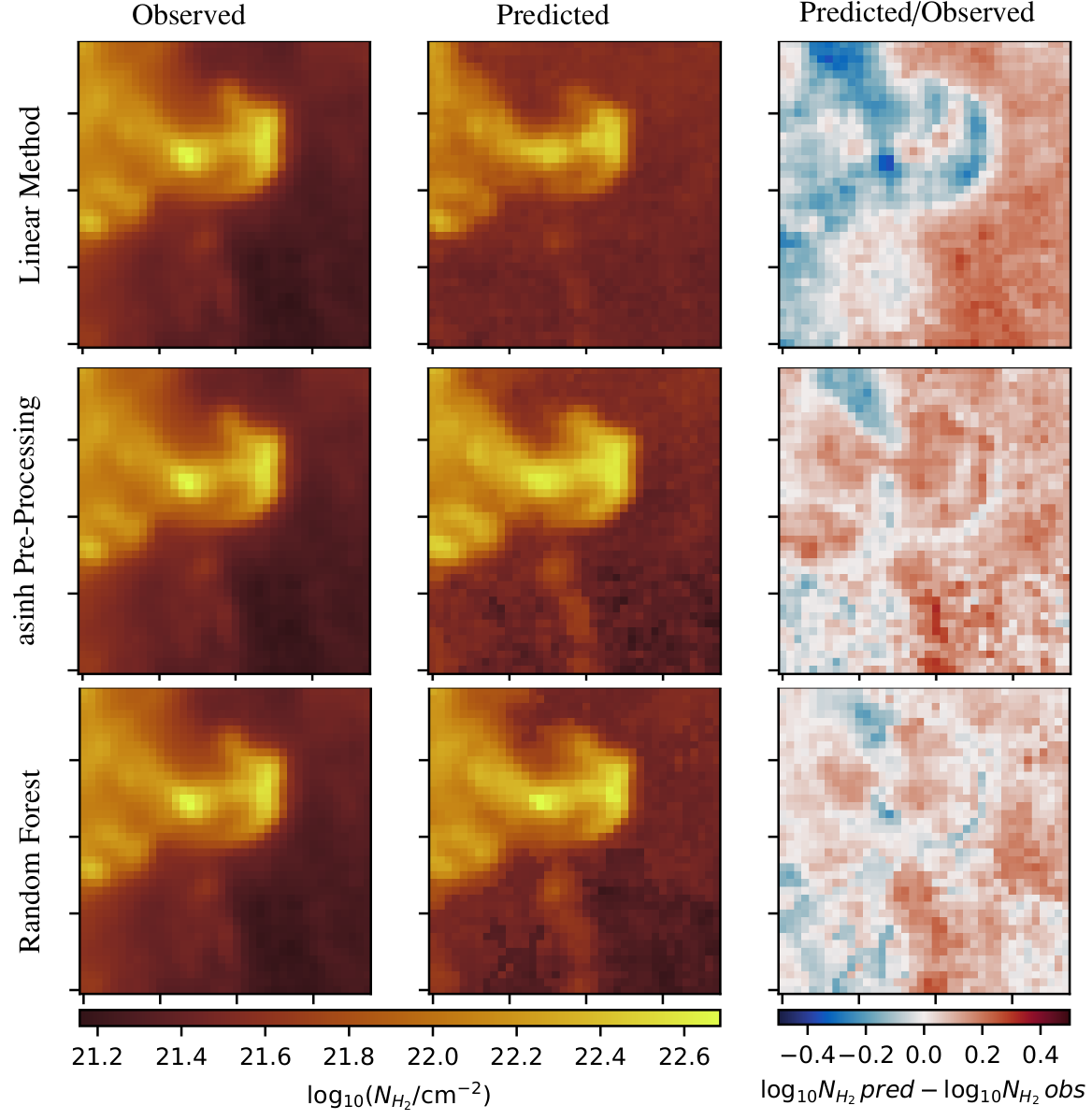
A random-forest model trained on the ORION-B observations predicts the H2 column density with a typical accuracy of about a factor 1.2 under conditions similar to those in Orion B. The most informative lines are the J=1-0 transitions of 12CO, 13CO, C18O, and HCO+, but their relative importance changes with environment. 12CO carries most information in diffuse gas, 13CO in translucent gas, C18O in filaments, while N2H+ and CH3OH become important in dense cores.
The result shows that the complementary response of several molecular species can be combined into a quantitative estimator of a fundamental physical quantity. It also provides a route toward estimating molecular-gas properties from ground-based spectral surveys when high-resolution dust measurements are not available.
Figure: Comparison of three methods for predicting the H2 column density in the Horsehead test region. For each method, the observed dust-based column-density map is shown next to the prediction from the molecular-line data, followed by their ratio. The random-forest reconstruction reproduces both the large-scale distribution and much of the smaller-scale structure.