The environment shapes the chemistry of dense cores
Back to all ORION-B & DAOISM results
Dense cores are the sites where stars begin to form, and their molecular composition provides information that cannot be obtained from dust emission alone. Much of our detailed knowledge, however, comes from a small number of cold and well-shielded nearby cores. To explore the full diversity of core chemistry, we analysed 25 molecular lines toward about one thousand dust-selected starless, prestellar, and protostellar objects distributed throughout Orion B.
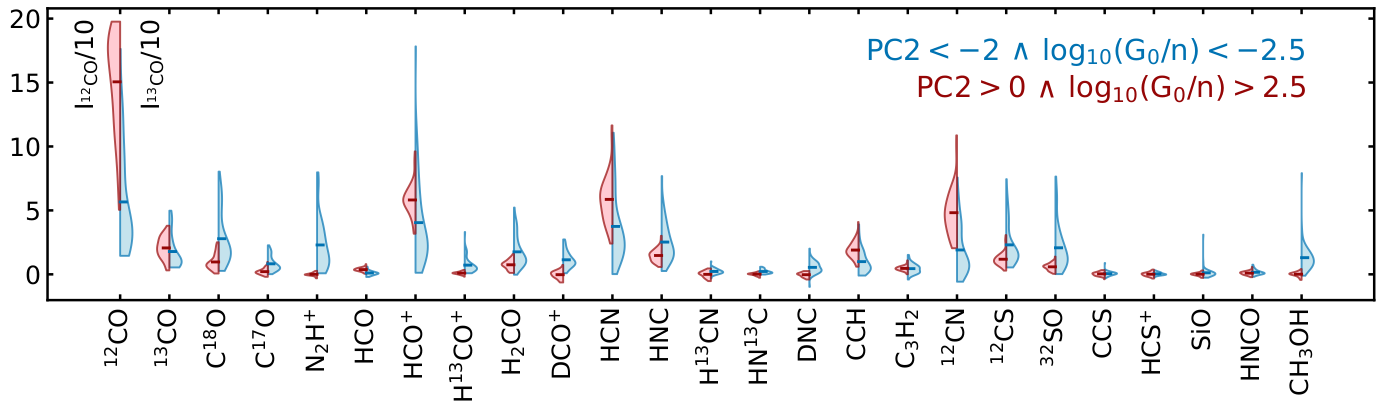
The strongest source of chemical diversity, after the total amount of material, is the local environment. A principal component analysis separates cold, shielded cores rich in N2H+, CH3OH and deuterated species from cores exposed to stronger far-ultraviolet radiation, where CN, HCO+, HCN and CCH become more prominent. The separation is tightly correlated with G0/n, the ratio between the incident FUV radiation field and the gas density. The two populations can have overlapping masses and densities: their different molecular fingerprints are therefore primarily environmental rather than simply structural.
This diversity has practical consequences for identifying the earliest stages of star formation. Surveys based only on classical cold-core tracers can miss a population of irradiated cores with comparable star-forming potential. The C18O line widths also show that Orion-B cores are more turbulent than the quiescent-core template commonly adopted in nearby clouds, reinforcing the need to account for environment when evaluating their dynamical state.
Figure: Molecular-line intensity distributions for two populations of cores living at opposite extremes of the FUV-to-density ratio G0/n. Cold, shielded cores show stronger N2H+, CH3OH and deuterated-species emission, whereas FUV-exposed cores are enhanced in species such as CN, HCO+ and HCN. The contrasting molecular fingerprints directly show how the environment shapes core chemistry.