Turbulence modes reveal where star formation is favored
Back to all ORION-B & DAOISM results
Supersonic turbulence is a major ingredient of molecular clouds. Its motions can be decomposed into solenoidal modes, dominated by shear and rotation, and compressive modes, associated with convergence and expansion. These two types of motion affect the density structure of a cloud differently and therefore provide a possible link between cloud dynamics and the efficiency of star formation. Using the ORION-B 13CO(1-0) data cube, we applied to observations a method developed to estimate the relative contribution of these turbulent modes from projected data.
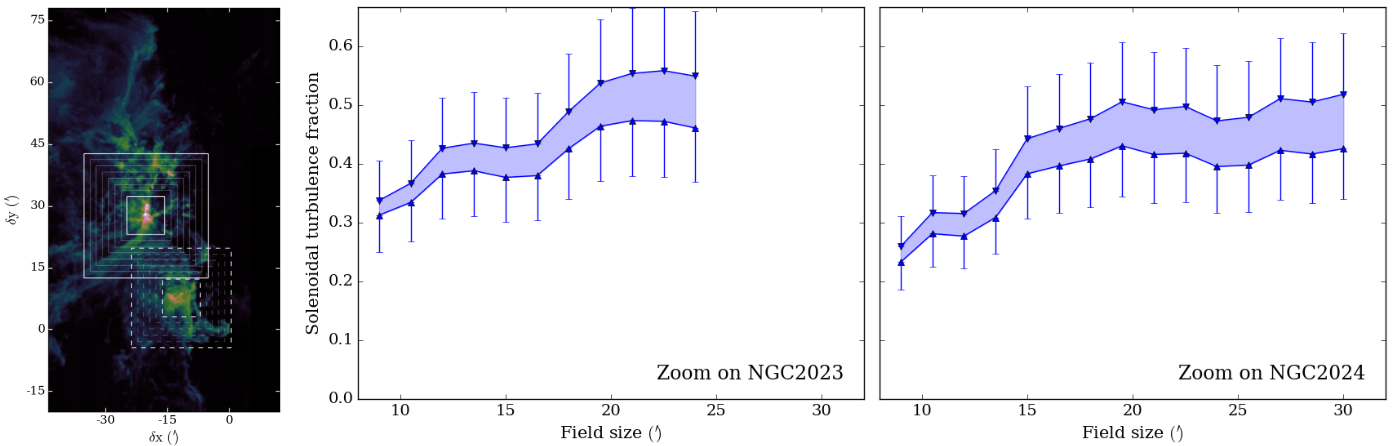
At the scale of the whole Orion B cloud, the turbulent momentum is dominated by solenoidal motions: the inferred solenoidal fraction is larger than about 0.72, compared with 2/3 for equipartition in highly supersonic turbulence. The balance changes markedly around the active star-forming regions NGC 2023 and NGC 2024. When progressively zooming into these regions, the solenoidal fraction decreases to values as low as about 0.25, revealing a strong local contribution from compressive motions.
This spatial variation connects the dynamics of the cloud to its star-forming activity. The large-scale dominance of solenoidal motions is consistent with the globally low star-formation efficiency of Orion B, while the strongest compressive motions occur precisely around its main sites of active star formation. The result shows that the balance between turbulent modes can be measured observationally and provides a new diagnostic for studying how the dynamics of molecular clouds regulate star formation.
Figure: Solenoidal fraction measured while progressively zooming into the NGC 2023 and NGC 2024 star-forming regions. The fraction decreases toward the centres of both regions, showing that compressive motions become increasingly important on the scales where star formation is active. The horizontal upper limit corresponds to equipartition between turbulent modes.