A dynamically young, gravitationally stable network of filaments in Orion B
Back to all ORION-B & DAOISM results
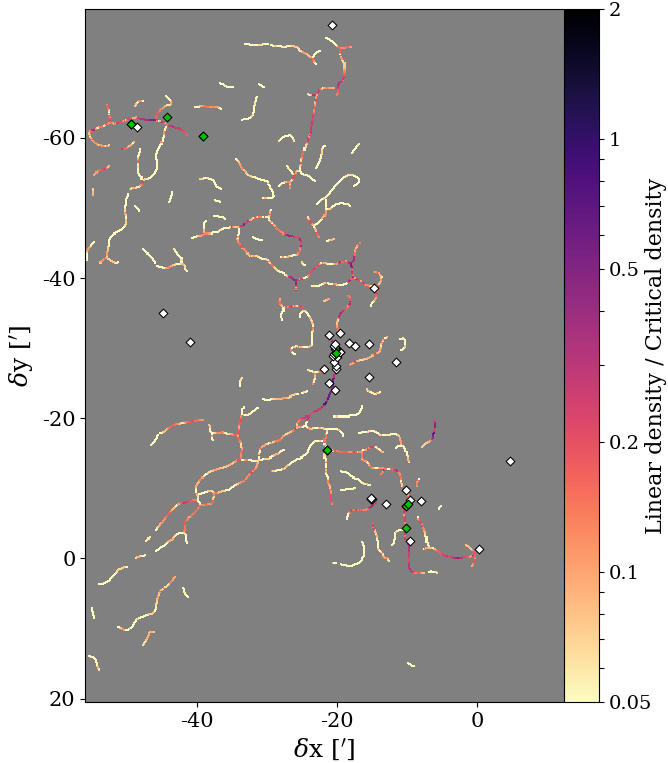
Gaseous filaments are a prominent feature of molecular clouds, as they contribute to channelling the diffuse gas from the cloud envelope into the dense cores which will eventually form stars. Their formation, structure and evolution are however not well understood. The ORION-B data allow us to identify and characterise in detail the shape, dynamics and molecular content of an entire network of filaments in the Orion B cloud, the first such large-field study of star-forming filaments. Compared to filaments studied in other clouds, the filaments in Orion B appear to be of typical dimensions (about 0.1 pc diameter) and the more massive ones are, as expected, linked to the presence of star-forming cores (as shown in the figure). However, they also display unusually low masses, which challenges our understanding of their formation: their presence in the entire cloud suggests that they play an major role in the structure of the gas even at low densities where gravity does not dominate over turbulence. Their density and velocity profiles also show that they actively contribute to the dissipation of turbulence. This further indicates how important filaments are in the transition between a turbulent cloud of gas and quiescent, pre-stellar cores.
Figure: the filaments in Orion B rarely reach densities high enough to collapse into star-forming cores. Newly formed stars in the cloud are marked as diamonds, the youngest ones in green — most of them follow closely the position of dense filaments.