Neural networks emulate complex ISM models in milliseconds
Back to all ORION-B & DAOISM results
The interpretation of line observations from the interstellar medium (ISM) requires comparisons with astrophysical numerical models to infer physical conditions such as thermal pressure, kinetic temperature, or visual extinction. These models can be too computationally expensive for Bayesian inference procedures that require thousands or millions of evaluations. They are therefore often replaced by interpolation on a precomputed model grid, whose accuracy is not always quantified.
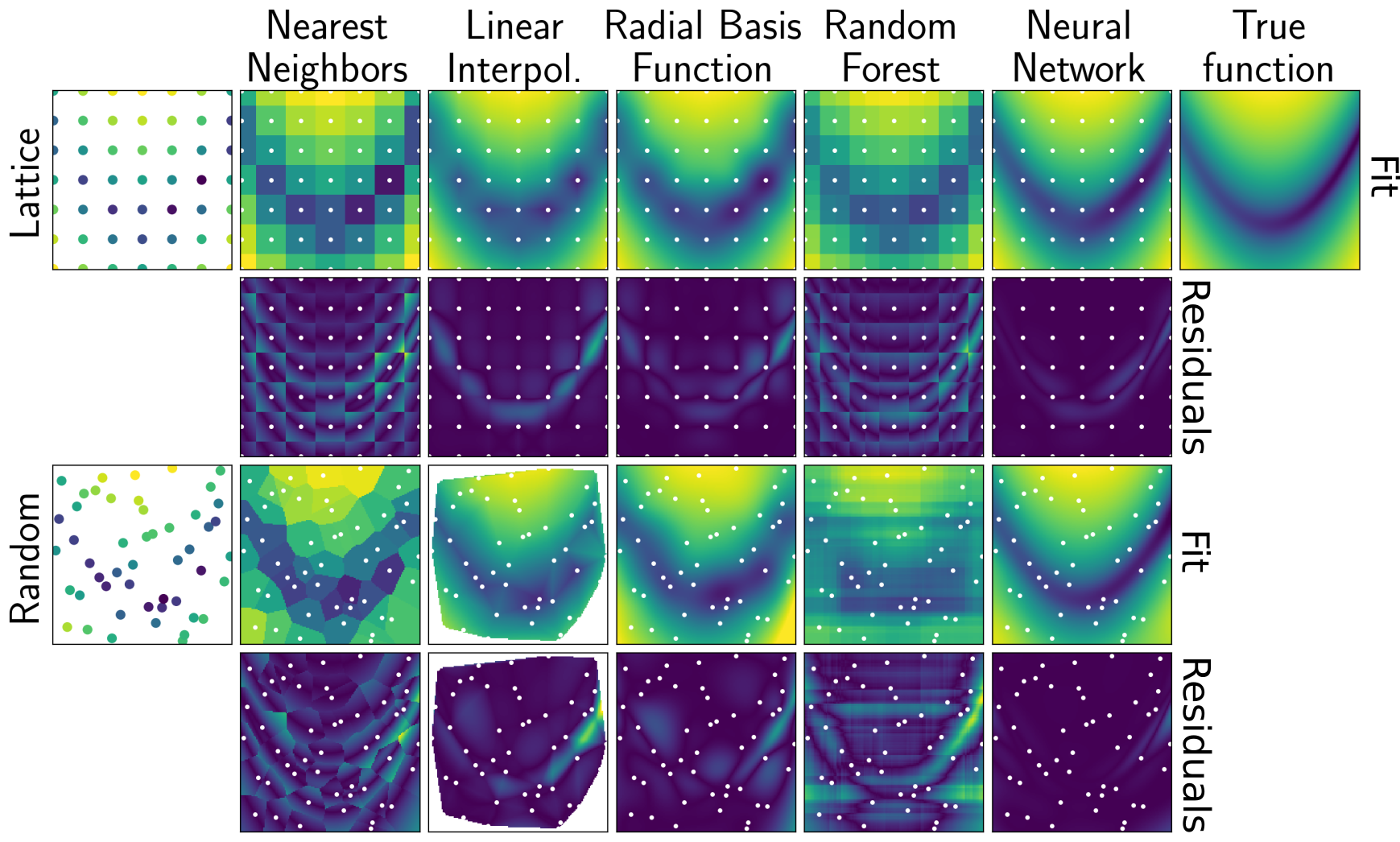
We developed neural-network emulators that reduce a model calculation from more than ten hours to a few milliseconds, while typically being two to three times more accurate than standard interpolation methods. The networks are designed specifically for the properties of ISM models: anomalous model outputs are automatically detected and ignored during training, while the large number of correlated outputs is divided into groups that can be learned by simpler dedicated networks.
Applied to the Meudon PDR code, the method provides fast and accurate predictions over large model grids and makes Bayesian inference on million-pixel, multi-line data sets computationally feasible. The implementation is available in the nnbma documentation and can be installed with pip install nnbma.
Figure: Comparison between interpolation and regression methods on a mathematical test function for grid-based and randomly distributed training sets. The neural-network approach provides a more accurate approximation while remaining suitable for the very fast evaluations required by large-scale inference.