Bayesian inference reconstructs large maps of physical conditions
Back to all ORION-B & DAOISM results
Modern millimeter instruments produce large maps containing many molecular lines, but converting these observations into maps of physical conditions is a difficult inverse problem. The solution must remain robust when the signal-to-noise ratio varies strongly across the field, avoid local minima, and quantify uncertainties. BEETROOTS was developed to address these requirements by combining an astrophysical forward model, Bayesian inference, and spatial regularization.
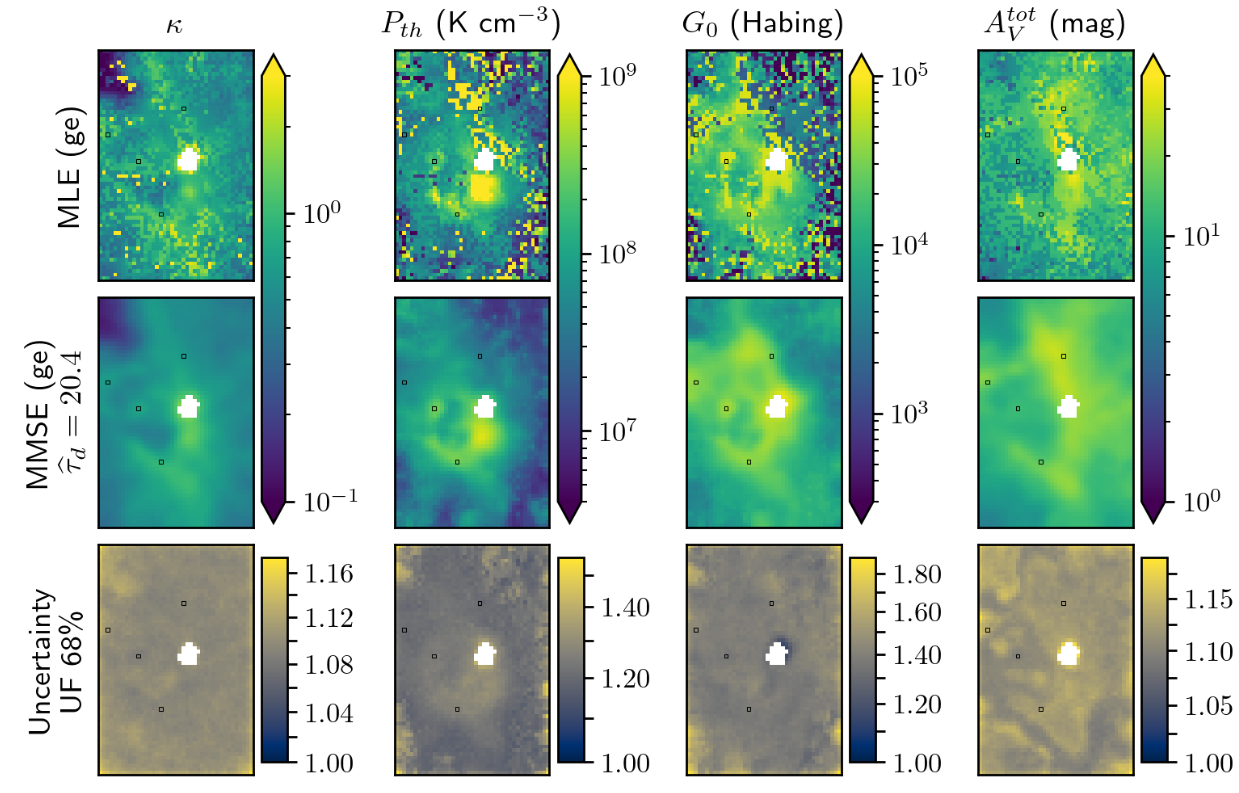
The method was first validated on synthetic data and then applied to Herschel molecular-line observations of the OMC-1 star-forming region. It reconstructs maps of the incident UV radiation field, thermal pressure, and extinction while providing uncertainty estimates at each position. In OMC-1, the inferred UV field agrees with independent estimates based on far-infrared luminosity, and the reconstructed thermal pressure is high in the dense regions and positively correlated with the UV field.
The result demonstrates that physically informed Bayesian inference can scale from individual spectra to thousands of spatially connected pixels while retaining both parameter estimates and their uncertainties. It provides a route toward systematic analysis of the large hyperspectral datasets produced by current and future observatories.
Figure: BEETROOTS reconstruction of OMC-1. From top to bottom, the rows show the maximum-likelihood estimate, the Bayesian mean estimate, and the corresponding uncertainty maps for the scaling factor, thermal pressure, UV radiation field, and visual extinction. The comparison shows both the spatial coherence of the inferred physical conditions and where the data constrain them most strongly.