Molecular lines reveal different regimes of interstellar gas
Back to all ORION-B & DAOISM results
Remote sensing is the only way to obtain information about the physical and chemical conditions of the interstellar medium. Molecular emission lines therefore play a central role: each transition provides a different view of the gas, but interpreting that view requires understanding how line emission responds to density, column density, UV illumination, excitation, chemistry, and optical depth. The ORION-B survey mapped a large fraction of the Orion B molecular cloud in about thirty lines at 3 mm, providing a resolved laboratory in which these effects can be disentangled.
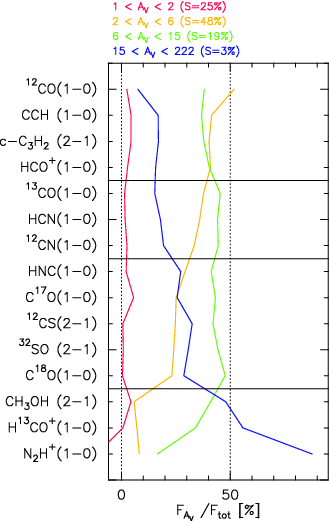
The survey reveals a clear differentiation between tracers. Some bright lines, including CO, HCN, HCO+ and HNC, receive substantial emission from relatively extended or intermediate-extinction gas, whereas species such as N2H+ are much more tightly associated with the densest material. In this sense, the ensemble of molecular lines forms a multidimensional diagnostic of the cloud: different species emphasize different physical regimes.
This resolved view of Orion B provides a calibration laboratory for interpreting molecular-line observations of unresolved clouds in the Milky Way and nearby galaxies. By understanding how the various tracers behave locally, we can better infer the mixture of physical conditions that contributes to a single telescope beam at larger distances.
Figure: Fraction of the total emission of different molecular lines arising from four ranges of visual extinction, used as a proxy for increasingly dense lines of sight. The figure shows that different species preferentially emit from different regimes, with N₂H⁺ standing out as particularly concentrated toward the highest-extinction gas.