CO isotopologues provide complementary views of molecular-cloud structure
Back to all ORION-B & DAOISM results
The three main isotopologues of carbon monoxide, 12CO, 13CO, and C18O, are among the most widely used probes of molecular gas. Because they differ in abundance and optical depth, they sample different depths and physical conditions along a line of sight. By observing two rotational transitions of each isotopologue toward Orion B, we can estimate their excitation temperatures, column densities, velocities, and line widths and quantify the precision of those measurements.
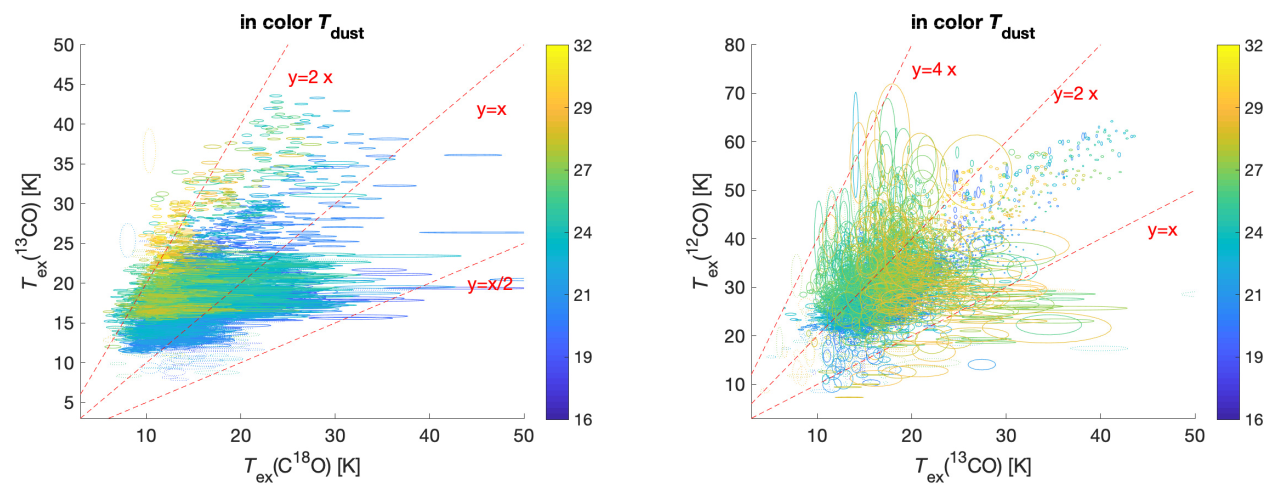
The three isotopologues show systematically different excitation temperatures: 12CO is the warmest, followed by 13CO and then C18O. Their relative abundances also vary across the cloud as selective photodissociation, chemical fractionation, and freeze-out compete in different environments. These effects make the isotopologues complementary probes of cloud structure. In particular, the ratio of their line intensities is shaped by both radiative transfer and chemistry and therefore contains more information than a simple abundance ratio.
The study also quantifies how much is gained by observing more than one transition of the same molecule. Simultaneously fitting two rotational lines strongly reduces degeneracies between excitation temperature and column density and improves the precision of the inferred physical parameters. This provides a quantitative basis for designing molecular-line observations and for interpreting CO emission in Galactic and extragalactic clouds.
Figure: Comparison of the excitation temperatures of the three CO isotopologues across Orion B. The systematic differences between 12CO, 13CO, and C18O show that they probe different physical layers of the cloud rather than sharing a single excitation temperature.