Multiple molecular species improve gas-property estimates when they trace the same gas
Back to all ORION-B & DAOISM results
The technological progress of millimeter-wavelength telescopes will soon make it common to observe multiple molecules over large fields of view, but with only few transitions. Assuming all these lines are emitting from the same element of interstellar gas allows us to constrain the estimation of physical parameters of the gas, such as temperature and volume density. However, when this assumption is not verified, it may generate some important biases. We explore this challenge based on the data of the ORION-B project.
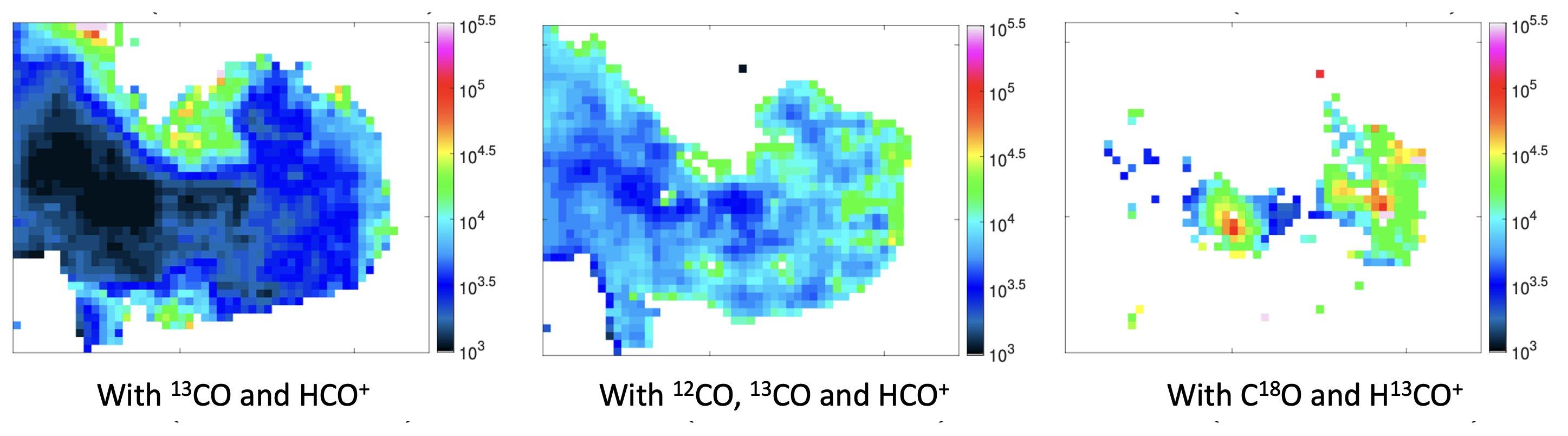
We use a radiative transfer model (RADEX) to estimate the gas characteristics in the Horsehead Nebula, by fitting different sets of lines emitted by CO and HCO+ isotopologues and study the theoretical accuracy that can be reached depending on the spectral lines and on the targeted region characteristics. We observe that the column densities of 13CO and C18O can be estimated with a 30% accuracy, while the volume density of H2 can typically only be obtained within a factor of 2. As shown in the figure, the fitted volume density and the estimation accuracy strongly depend on the considered chemical species. To explain these differences, we demonstrate with simulations that the estimations can be strongly biased in case of an inappropriate chemical assumption.
Figure: Depending on the considered set of species, the map of estimated volume densities in the Horsehead changes dramatically. The pixels for which the estimation accuracy is insufficient have been left in white.