UV-illuminated gas contributes strongly to HCN emission
Back to all ORION-B & DAOISM results
HCN emission is widely used to estimate the amount of dense molecular gas in the Milky Way and in external galaxies. The wide-field ORION-B maps make it possible to determine where this emission actually originates inside a resolved giant molecular cloud and how it responds to density and ultraviolet illumination.
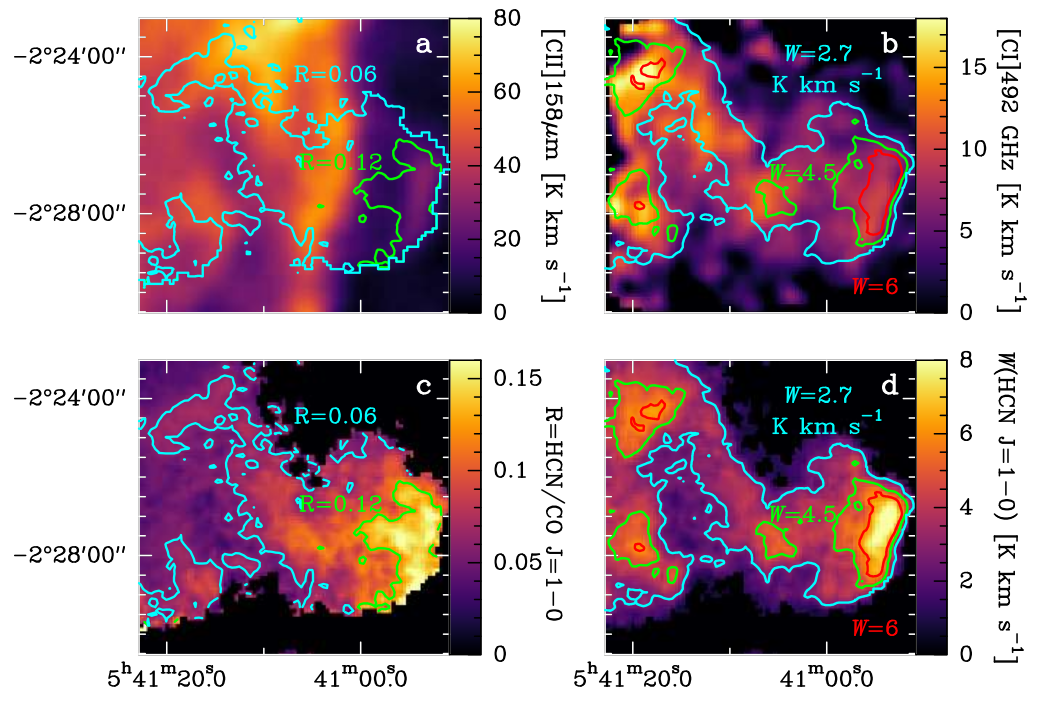
About 70% of the total HCN(1-0) luminosity in Orion B arises from lines of sight with visual extinction below 8 magnitudes. Much of the emission is therefore produced by extended gas with densities below about 10^4 cm^-3, rather than only by dense star-forming clumps. At UV-illuminated cloud edges, HCN is enhanced by photochemistry and its excitation can be boosted by collisions with electrons. These regions can consequently display high HCN/CO intensity ratios even at low gas density.
The result provides a physical explanation for the large-scale HCN emission seen in molecular clouds and helps connect resolved Galactic observations to measurements of entire clouds and galaxies. HCN luminosity carries information not only about dense gas, but also about the radiation field, chemistry, and excitation of the more extended molecular medium.
Figure: A 30-arcsecond view of the Horsehead nebula comparing tracers of the UV-illuminated cloud edge with HCN emission. The enhanced HCN/CO ratio follows the irradiated edge, illustrating how UV illumination can produce bright HCN emission outside dense star-forming gas.