A multilayer model reveals physical conditions along the line of sight
Back to all ORION-B & DAOISM results
A telescope spectrum combines the emission of all the gas encountered along a line of sight. When a dense filament or core is embedded in a more diffuse envelope, treating this mixture as a single homogeneous component can hide important information and bias the inferred physical conditions. We therefore developed a multilayer radiative-transfer model in which a dense inner layer is surrounded by two more translucent layers.
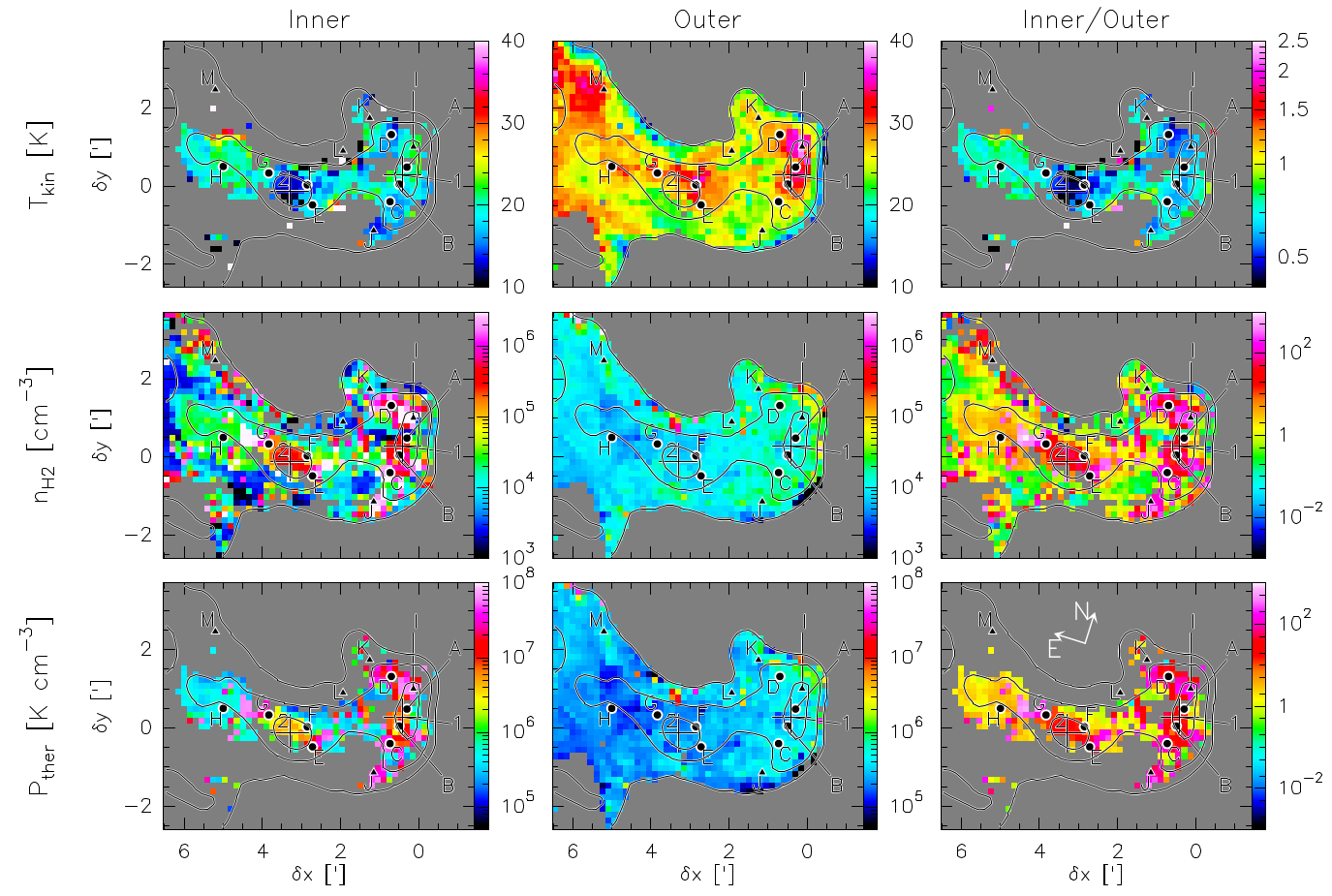
Applied simultaneously to the low-J lines of CO and HCO+ isotopologues in the Horsehead nebula, this simple "sandwich" geometry reproduces the observed line intensities and separates the contribution of gas at different depths. The different molecular lines are found to probe different layers: for example, about 85% of the 12CO(1-0) emission comes from the foreground layer. The reconstructed maps show a warmer outer envelope, while the inner layer becomes colder and much denser toward the filament and dense cores.
By explicitly representing the structure hidden along the line of sight, the method turns several overlapping molecular lines into depth-dependent information on temperature, density, pressure, chemistry, and kinematics. It provides a more realistic framework for interpreting molecular spectra in structured clouds than a single homogeneous gas component.
Figure: Reconstructed physical conditions in the inner and outer layers of the Horsehead nebula. Maps of kinetic temperature, volume density, and thermal pressure show that the molecular lines separate a relatively warm envelope from a colder and denser inner filament and its cores.