Unresolved line profiles retain information about sub-beam cloud structure
Back to all ORION-B & DAOISM results
In external galaxies, a telescope beam typically averages molecular emission over tens of parsecs. The resulting spectrum mixes many unresolved density and velocity structures, even though its peak brightness and linewidth are then used to infer basic cloud properties. To quantify this effect, we generated 1000 synthetic unresolved clouds by resampling the high-resolution ORION-B multi-line observations while imposing different density and velocity fields.
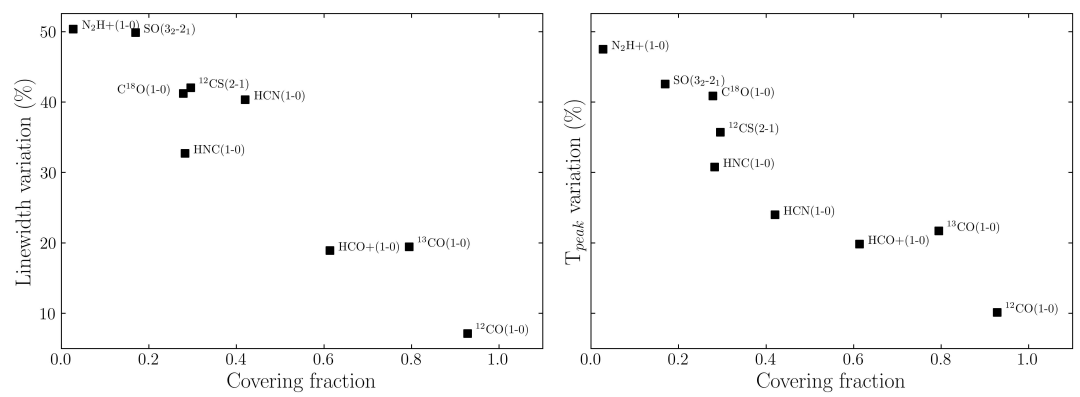
The unresolved line parameters vary significantly even when the underlying cloud mass and velocity amplitude are fixed. Lines emitted over most of the cloud, such as CO, are comparatively stable, whereas lines with small spatial covering fractions vary much more strongly. The effect reaches about a factor of two for N2H+(1-0). The line shape also carries information: as the sub-beam velocity field becomes spatially smoother, several dense-gas tracers depart increasingly from a Gaussian profile.
The beam-averaged spectrum is therefore not only a blurred version of the resolved cloud. Its tracer-dependent variability reflects how the emitting gas is distributed below the resolution of the observation. Quantifying this effect is essential when comparing molecular-cloud properties derived from unresolved extragalactic spectra.
Figure: Maximum variation of the unresolved linewidth and peak brightness temperature as a function of the spatial covering fraction of each molecular line. Compact tracers show the largest variability, while extended tracers such as CO remain much more stable. This directly links the uncertainty of an unresolved line measurement to the sub-beam distribution of its emission.