Molecular spectra reveal the distribution of dense gas inside an unresolved beam
Back to all ORION-B & DAOISM results
A single telescope beam in another galaxy can contain diffuse molecular gas, dense structures, and star-forming material at the same time. Instead of assigning each molecular line to one characteristic gas density, we model the unresolved 3 mm line intensities as the emission produced by an underlying distribution of H2 column densities within the beam. The relation between line emission and column density is calibrated empirically from the resolved ORION-B observations.
The method recovers the known column-density distribution of Orion B and was then applied to six molecular lines observed across a 700 x 700 pc region of M51. In the spiral arm, the inferred distributions are dominated by high-column-density power-law tails with slopes compatible with gravitational collapse. Outside the arm, the distributions are predominantly log-normal, as expected for gas whose structure is mainly shaped by supersonic isothermal turbulence.
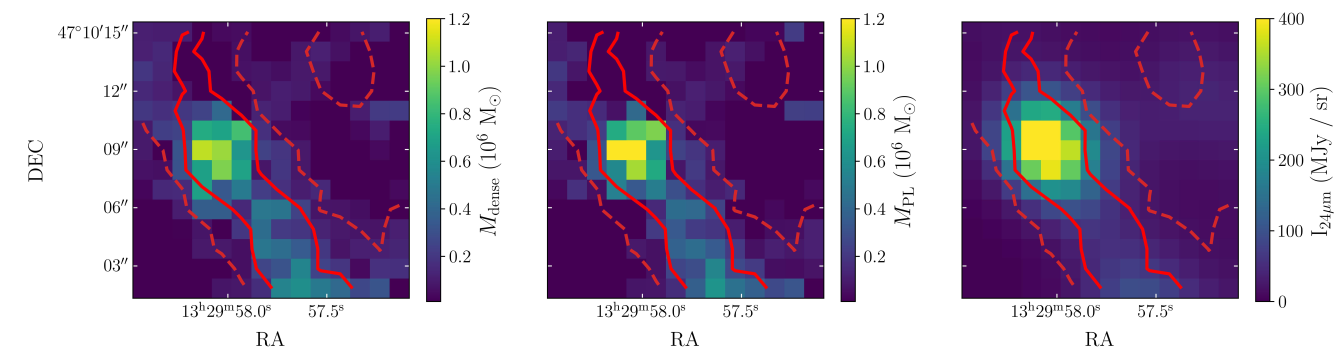
The mass contained in the power-law component correlates strongly and almost linearly with the 24 micrometer emission used as a proxy for star formation. Thus unresolved multi-line observations can constrain not only the average amount of molecular gas, but also the statistical distribution of dense gas hidden below the telescope beam.
Figure: Spatial distributions in M51 of the dense-gas mass, the mass in the power-law part of the inferred column-density distribution, and the 24 micrometer emission. The three maps show a closely related structure along the spiral arm, visually linking the inferred high-column-density gas to the regions of active star formation.